

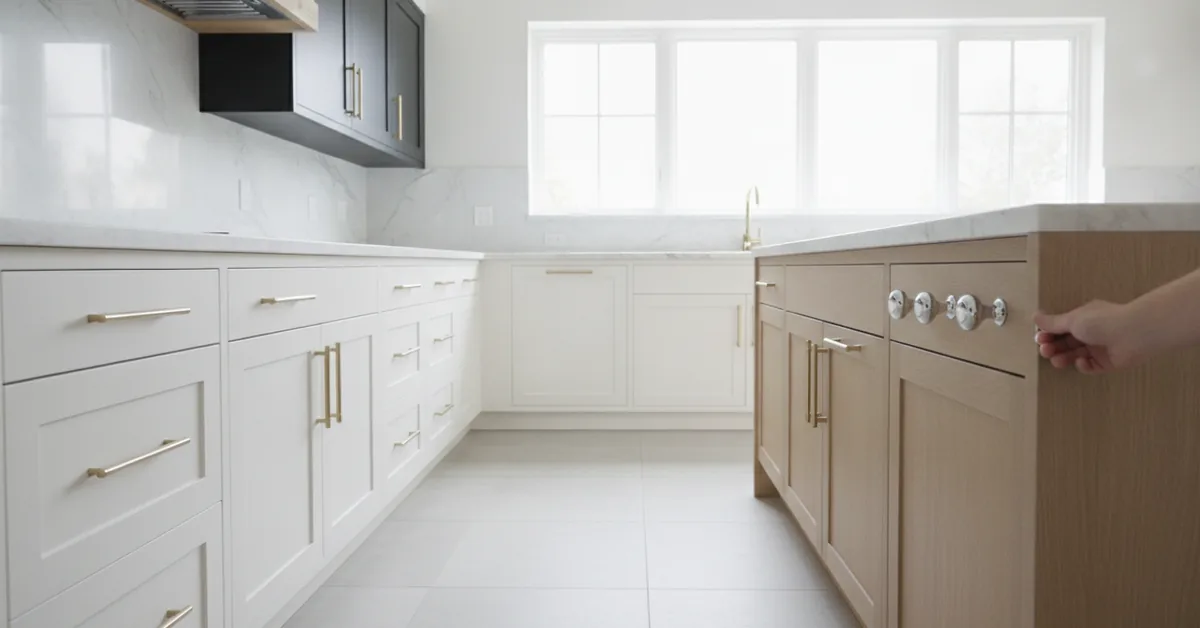
Last Tuesday, I stood in a client's newly remodeled kitchen in Seattle, watching her struggle to open a heavy, integrated pantry door. The designer had specified a delicate, 1-inch brass knob for a door that required 15 pounds of pull force to break the magnetic seal of the high-end column refrigerator behind it. It is a scene I see far too often: beautiful hardware completely mismatched to the physical reality of the cabinetry. Cabinet hardware is not just the jewelry of the kitchen; it is the physical touchpoint where your hand meets my craftsmanship thousands of times a year. When you choose the wrong profile, scale, or mounting style, you do not just compromise the aesthetic—you risk damaging the wood face, stripping the screw threads, and frustrating your daily workflow.
The Master Cabinet Maker's Hardware Blueprint
The 1/3 Scale Rule: Pulls should generally span approximately one-third of the total width of a drawer front to
- The 1/3 Scale Rule: Pulls should generally span approximately one-third of the total width of a drawer front to maintain visual balance and distribute physical tension evenly across the wood grain.
- Ergonomic Clearance: Always verify the projection clearance; a quality pull requires at least 1 inch of finger clearance to prevent fingernails from scratching the cabinet finish over time.
- Mechanical Compatibility: Heavy-duty pantry pull-outs and integrated appliances must bypass standard cabinet screws in favor of through-bolts or reinforced backplates to prevent wood splitting.
- Finish Cohesion: Do not match metals perfectly; instead, align the undertones of your hardware with your plumbing fixtures to create a curated, high-end design rather than a sterile showroom look.
The Anatomy of Hardware: Knobs vs. Pulls vs. Handles
In my workshop, we categorize hardware by its physical footprint and how it distributes the physical load of a cabinet door or drawer. A knob mounts via a single screw, making it highly versatile but susceptible to spinning over years of repeated use. A pull, often called a cup pull or bar pull, utilizes two or more mounting points, which distributes the pulling force across a wider surface area of the cabinet face. Handles, particularly large appliance pulls, feature heavy-duty internal threading designed to withstand the high-torque resistance of modern gasketing.
Choosing between these options is not merely an aesthetic choice; it is an engineering decision. For example, solid wood drawer fronts expand and contract across their grain with seasonal humidity changes. If you install a rigid, wide pull on a wide solid wood drawer without slightly oversized pilot holes, the wood's natural movement can shear the mounting screws or split the drawer face. Knobs are far more forgiving of wood movement because of their single-point anchor, making them ideal for traditional five-piece shaker doors and smaller drawers.
The Technical Comparison: Weight, Function, and Placement
To help clients visualize how to distribute these elements across a full kitchen layout, I developed a functional matrix during my years of custom installations. This grid balances the ergonomic needs of the user with the structural limits of the cabinetry.
| Hardware Type | Best Application | Average Pull Force Rating | Installation Vulnerability | Recommended Center-to-Center Spacing |
|---|---|---|---|---|
| Standard Knob | Upper cabinet doors, small vanity drawers | Low (under 10 lbs) | Spinning/loosening over time | Single-point anchor |
| Cup / Bin Pull | Traditional drawers, trash pull-outs | Medium-High (up to 30 lbs) | Traps dust/debris internally | 3 inches to 5 inches |
| Bar Pull (T-Bar) | Slab drawers, modern flat-panel doors | High (up to 40 lbs) | Catching pockets/clothing on exposed ends | 3 inches to 12+ inches (1/3 drawer width) |
| Appliance Pull | Integrated refrigerators, heavy pantries | Very High (50+ lbs) | Stripping wood threads if not through-bolted | 12 inches to 18 inches |
The Pitfalls of Cheap Hardware: Lessons from the Finishing Room
I once had a client who insisted on purchasing cheap, hollow zinc-alloy pulls online to save a few hundred dollars on a $40,000 custom white oak kitchen. Within six months, the acidic oils from their hands had eaten through the thin electroplated brass finish, leaving ugly grey pot-metal exposed where their fingers touched the metal. Worse, the cast threads inside the pulls stripped out under the weight of the soft-close drawer slides.
When selecting materials, always demand solid brass, bronze, or high-grade stainless steel (Grade 304). Solid metals can be refinished, they carry a satisfying physical weight, and their threads are machined directly into the metal rather than pressed in. If you are opting for a living finish like unlacquered brass, expect it to develop a rich, localized patina where it is touched most often. If you prefer a pristine look, choose a physical vapor deposition (PVD) finish, which molecularly bonds the color to the metal, rendering it virtually impervious to scratches and chemical wear.
A Step-by-Step Guide to Mapping Your Kitchen Hardware
Before you drill a single hole into your expensive new cabinet doors, you must create a physical mapping plan. I advise my clients to follow this systematic approach to ensure both ergonomic comfort and visual symmetry.
- Determine the Placement Rules: For upper cabinets, the standard placement is vertical, with the bottom of the hardware aligned with the top of the bottom rail. For lower doors, place the hardware horizontal or vertical, aligned with the bottom of the top rail.
- Calculate the Drawer Proportions: Measure each drawer front. If a drawer is wider than 30 inches, plan for either one extra-wide pull (using the 1/3 rule) or two smaller pulls placed at the 1/6 and 5/6 marks to prevent the drawer from racking when pulled with one hand.
- Build a Physical Template: Never rely on cardboard templates. Create a rigid template using 1/4-inch plywood or acrylic. Drill your pilot holes through this template to guarantee absolute consistency across all doors.
- Test the Scale with Blue Painter's Tape: Cut strips of blue tape to the exact length of the pulls you are considering. Stick them to the cabinet faces to evaluate the visual weight from a distance before ordering your hardware package.
- Verify Screw Lengths: Standard cabinet doors are 3/4-inch thick, but drawer boxes often feature a double-front design (the drawer box front plus the decorative face), requiring longer 1-3/4-inch breakaway screws. Ensure your hardware package includes both sizes.
Behind the Scenes: Why the "Feel" Matters More Than the Look
In my shop, we perform what I call the "blind touch test." I have clients close their eyes and reach out to grab different hardware samples mounted on a mock-up door. Your hand detects imperfections that your eyes easily overlook. You will instantly feel the difference between a cheap pull with sharp, unchamfered back edges and a hand-polished pull with gently radiused corners. Because you will interact with these objects thousands of times a year, the tactile feedback of the metal—how warm it feels to the touch, how much grip it offers, and whether your fingers slip off—is ultimately more critical to your long-term satisfaction than how it looks in a static photograph.
Frequently Asked Questions
- Can I mix different hardware finishes in the same kitchen without it looking chaotic?
- Yes, but you must limit yourself to two finishes and establish a clear hierarchy. I recommend keeping all cabinet hardware in one finish (such as oil-rubbed bronze) while matching your plumbing fixture and light pendants to a secondary finish (such as unlacquered brass). This creates a layered, intentional look rather than a mismatched accident.
- How do I prevent my cabinet knobs from constantly spinning and loosening?
- The secret is using knobs that feature a small, built-in spur on the backplate, often called a "spur" or "boss." This tiny metal pin bites into the wood face when tightened, preventing the knob from rotating. Alternatively, you can apply a tiny drop of thread-locking compound (like blue Loctite) to the screw threads during final installation.
- Should integrated appliances have the exact same hardware style as the rest of the cabinets?
- No, they should not. Integrated refrigerators and dishwashers require significantly more force to open due to their airtight magnetic seals. Standard cabinet pulls are not engineered for this stress and will bend or pull out. You must purchase dedicated "appliance pulls" from the same design collection, which feature thicker mounting posts and deeper thread engagement to handle the high load.