

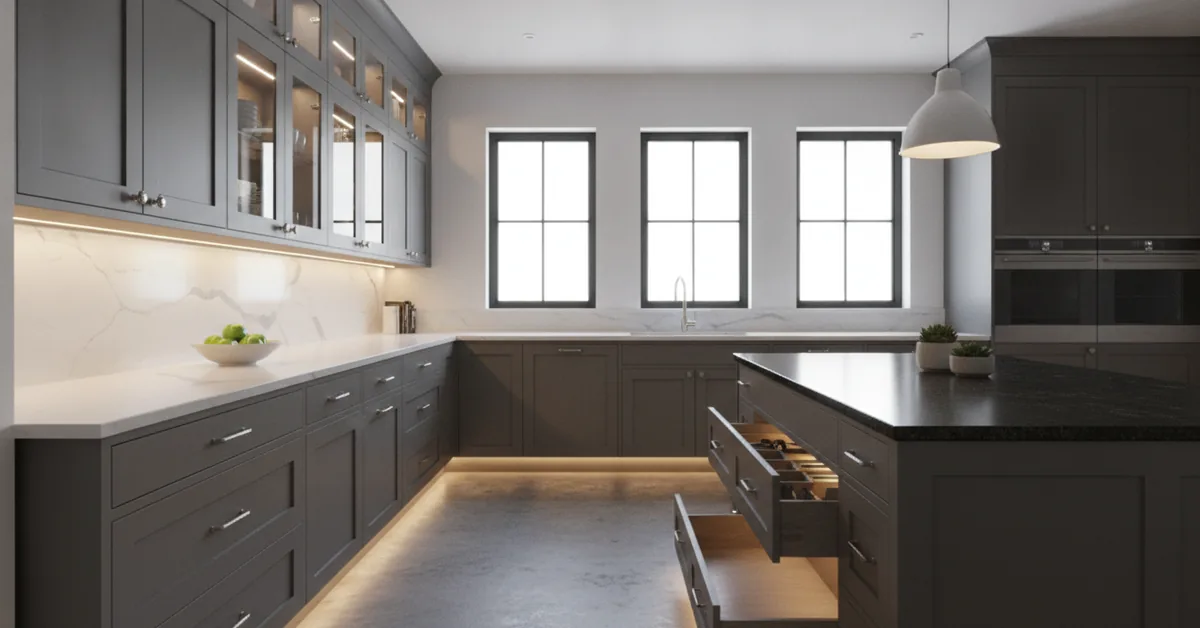
Last month, I was called to a stunning waterfront home in Naples, Florida, to inspect a custom white oak kitchen we had installed just two years prior. The homeowner was frustrated; despite spending over eighty thousand dollars on premium, book-matched rift-sawn cabinetry, the kitchen felt flat and clinical at night. The culprit wasn't my woodwork, but rather a classic electrical subcontracting oversight: they had installed cheap, dotted 12-volt LED tape light inside a shallow plastic channel, casting harsh, pixelated shadows across the quartzite countertops and reflecting ugly yellow dots on the polished backsplash. This is the inconvenient truth of modern high-end kitchen design: the finest cabinetry in the world will look mediocre if your lighting strategy is treated as an afterthought or executed with outdated technology.
The Core Pillars of Modern Cabinet Lighting Integration
Continuous Dot-Free Illumination: Transitioning from traditional surface-mounted, pixelated LED strips to recessed
- Continuous Dot-Free Illumination: Transitioning from traditional surface-mounted, pixelated LED strips to recessed Chip-on-Board (COB) technology to eliminate reflective hotspots on polished stone and glass surfaces.
- Precision Joinery Integration: Designing dedicated, CNC-milled routing channels within the cabinet box components during the shop drawing phase, rather than retrofitting fixtures on-site.
- Dynamic Kelvin Tuning: Implementing human-centric, tunable white systems (ranging from 2200K to 5000K) that adapt throughout the day to complement both natural daylight and wood grain warmth.
- Low-Voltage Infrastructure: Centralizing driver locations in accessible, ventilated service panels rather than hiding individual transformers behind finished crown moldings or toe kicks.
The Death of the Diode: Why COB Technology Changes Everything
For years, the standard for under-cabinet lighting was the flexible LED strip populated with Surface Mounted Diodes (SMD). Even with a frosted diffuser, these strips projected a distinct "dotted" pattern onto reflective countertops like polished granite or engineered quartz. In my shop, we have completely phased out SMD strips in favor of Chip-on-Board (COB) LED technology. COB lights place hundreds of tiny diodes directly onto a single substrate under a continuous phosphor coating, creating a seamless, unbroken line of light.
When we mill a shallow 1/4-inch deep channel into the underside of our upper cabinets, a COB strip allows us to achieve a perfectly uniform glow even when the light source is mere inches from the countertop. This shift is particularly critical when working with dark, highly figured wood species like walnut or stained rift oak. Standard SMD lights tend to wash out the natural variations in the wood grain, whereas the high Color Rendering Index (CRI) of modern COB LEDs—typically 95 or higher—brings out the deep, organic undertones of the timber without creating artificial glare.
Comparing Modern Cabinet Lighting Technologies
To help clients and designers navigate the rapidly evolving lighting landscape, I have compiled a technical comparison of the systems we currently specify and integrate into our custom cabinet builds.
| Lighting Technology | Typical Profile Depth | CRI Range | Best Application | Primary Limitation |
|---|---|---|---|---|
| COB (Chip-on-Board) LED Tape | 1/8" to 1/4" (Very Low) | 95 - 98 | Under-cabinet task areas, highly reflective countertops | Requires precise voltage drop calculations over long runs |
| Micro-Profile Extrusions | 3/8" to 1/2" (Recessed) | 90 - 95 | Vertical interior pantry lighting, glass-front display cabinets | Requires advanced CNC routing during box fabrication |
| Tunable White (Dynamic) | 1/4" to 1/2" | 93 - 97 | Multi-use open-plan kitchens, changing daylight conditions | Higher control system complexity and driver costs |
| Low-Voltage Puck Lights | 1/2" to 5/8" (Surface/Recessed) | 90 - 93 | Focused accent lighting in architectural niches | Creates localized scallops of light rather than even washes |
Behind-the-Scenes: The Mechanics of Invisible Integration
True luxury is felt, not seen. In my cabinet shop, our goal is to make the physical lighting hardware completely disappear. Achieving this requires meticulous planning during the drafting phase. We utilize a 3-axis CNC router to cut precise 16mm-wide by 12mm-deep channels into the underside of our wall cabinet bottoms, the interior gables of our pantries, and the underside of our island countertops. By recessing the aluminum extrusion flush with the wood surface, the light source remains hidden from almost every viewing angle in the room.
Another major point of failure I observe in standard kitchen remodels is wire management. Electricians often drill messy holes through the backs of beautiful cabinet boxes, leaving exposed wires inside the shelves. To prevent this, we engineer a 1/2-inch service void behind our cabinet back panels. This double-back design allows all low-voltage wiring to run cleanly behind the finished interior of the cabinet, completely hidden from view, while still remaining accessible for future maintenance via removable service panels inside the sink base or pantry tower.
The Rise of Tunable White and Human-Centric Kitchens
One of the most exciting design trends I am integrating into high-end homes is human-centric lighting, specifically tunable white technology. The color temperature of light profoundly affects our circadian rhythms and how we perceive color. A kitchen that is bright and energetic at 8:00 AM requires a crisp, cool 4000K light to aid in meal preparation and clean-up. However, that same 4000K light feels incredibly harsh and uninviting at 9:00 PM when you are entertaining guests over a glass of wine. Tunable white systems allow us to dynamically shift the color temperature from a warm, candle-like 2200K up to a daylight-mimicking 5000K.
When paired with smart home automation platforms like Lutron Homeworks or Crestron, we can program the cabinet lighting to automatically mirror the natural progression of the sun. This seamless transition prevents the wood tones from looking muddy in the evening and ensures that your marble or quartzite countertops retain their natural brilliance regardless of the time of day. It is no longer just about seeing your work surface; it is about curating an emotional atmosphere within the home's primary gathering space.
A Cabinet Maker's Step-by-Step Guide to Planning Your Lighting
If you are planning a kitchen renovation or building a custom home, do not leave your cabinet lighting to chance. Follow this logical sequence to ensure a flawless, integrated result:
- Specify Lighting During Cabinet Design: Ensure your cabinet maker coordinates directly with your interior designer and electrical engineer before the wood is cut. Demand shop drawings that show exact routing locations and wire chase paths.
- Select the Countertop Material First: Your countertop selection dictates your lighting needs. Highly polished, dark surfaces require ultra-dense COB lighting to prevent reflective hot spots, while matte or honed surfaces are more forgiving.
- Plan for Accessible Driver Locations: Never allow your contractor to bury LED drivers (transformers) behind drywall or crown molding where they cannot be serviced. Group them in a ventilated utility closet, pantry cabinet, or mechanical room.
- Verify Color Rendering Index (CRI): Insist on lighting fixtures with a CRI of 95 or higher, and an R9 value (red color rendering) above 80. This ensures that food, wood grain, and skin tones look natural and vibrant.
- Coordinate the Control System: Decide early on how you want to control the lights—whether through physical dimmers, voice commands, motion sensors, or a centralized smart home keypad—to ensure the correct dimmable drivers are purchased.
Advanced Cabinet Lighting Technology FAQ
- Why is the CRI (Color Rendering Index) so critical when lighting custom wood cabinetry?
- CRI measures how accurately a light source reveals the true colors of an object compared to natural sunlight. For custom cabinetry, particularly woods with rich red, orange, or brown undertones like cherry, walnut, or mahogany, a low CRI light (under 85) will make the wood look gray, lifeless, and artificially stained. High CRI lighting (95+) ensures the natural depth, warmth, and intricate grain patterns of the timber are fully realized.
- How do you prevent voltage drop in extensive cabinet lighting layouts?
- Voltage drop occurs when low-voltage power (typically 12V or 24V) travels over a long distance, causing the lights at the end of the run to appear dimmer than those at the start. To prevent this in our designs, we exclusively use 24-volt systems, which can carry power twice as far as 12-volt systems without noticeable drop. Additionally, we carefully calculate wire gauges based on run length and load, and we home-run individual wire lines back to the driver rather than daisy-chaining multiple cabinet sections together.
- Is it better to recess or surface-mount under-cabinet light fixtures?
- Recessing is always the superior choice for high-end custom cabinetry. Surface-mounted fixtures, even low-profile ones, create a visible lip that can be seen when seated at an island or dining table, breaking the clean lines of the kitchen. Recessing the fixture into a routed channel in the cabinet bottom keeps the light source entirely hidden, delivering a clean, architectural wash of light without compromising the clean lines of the joinery.